Welcome to My TV Feelings

  • Richard and the Marble

    Like many of the best lessons in my life, this TV feeling came from the B plot of a sitcom and became a foundation of my writing process (and life). I am, in fact, applying this lesson as I work on the entire project of My TV Feelings which means you get to see a TV feeling in action. Beep beep!

    ***

    Caroline in the City was an NBC sitcom that ran from 1995 to 1999 which was almost perfectly timed to my high school career. (Class of 2000: Go Owls.) It was an ideal program for me in that it featured grownups, a perfect apartment, and stakes that did not overwhelm me with anxiety. 

    The titular Caroline was an artist with a semi-autobiographical comic strip about her life [in the city] that ran in newspapers across the country. She had a one-sided rivalry with Kathy, Fruitopia in the fridge, and had moved from Wisconsin to New York to make it big. And she did! 

    Her colleague Richard was an artist who made abstract paintings for which he struggled to find an audience. He needed to pay his bills and, as seen in the pilot episode, had taken a job with Caroline as her comics colorist despite their disparate disciplines. Richard had a dry sense of humor, and Caroline was walking sunshine. We were teed up from the start for some solid banter and ribbing.

    While I enjoyed said banter and ribbing and was invested in the interpersonal relationships, I truly loved seeing their artistic lives and studio spaces. I would have gladly watched an episode solely dedicated to studio tours, no plot necessary. There is a direct line from me watching Caroline in the City to me watching every PBS art documentary in their catalog. 

    ***

    The origin of this TV feeling is in the episode called “The Perfect Streak” from the second season. It was broadcast in January of 1997 which means this TV feeling’s pearl anniversary is in seven months. (No gifts, please.)

    In the episode, Richard obtained a marble slab from a man whose ex left it in his apartment along with a mountain of devastation. He had put out the call: if Richard could move it, it was his for free. Since one should never turn down a free slab of marble worth many thousands of dollars, Richard showed up with a dolly and a plan: He would work on it in Caroline’s living room because she had the larger place and he couldn’t chance angering his neighbors.

    The marble slab was all possibility, and Richard was eager to work with this ancient form. We did not see his process, but we heard the loud banging and chiseling all the night from Caroline’s bedroom as she, preoccupied with a situation with her boyfriend, lay awake. Notably, she was undisturbed by the sounds of Richard’s art-making which goes to show 1.) How preoccupied she was, and 2.) Her respect for Richard’s dedication to his art. 

    In the morning, Caroline returned to her living room to see it covered with large chunks of marble. Assuming it to be an abstract work, she tip-toed her way into a compliment before Richard told her that he had failed: he had not made a sculpture. Well, not the one he wanted. He had planned on creating a statue of Electra, a tragic character of The Oresteia, but it wasn’t quite right. He kept going and going until he chiseled it down to a small horse figurine just a few inches tall.

    Richard had precisely created the knight chess piece.

    ***

    For the past couple decades, the lesson of Richard and the marble has served as a tool to navigate my overthinking and dread. As the project of My TV Feelings probably indicates, I am someone with a lot of feelings and thoughts about those feelings and thoughts about my thoughts about those feelings. I have been known to make a weighted Pros and Cons list so that I can make the most reasonable decision, then throw out the list because the metrics are not sound. 

    “Remember Richard and the marble” is practical guidance. It is active: Put down the chisel and mallet. It is okay if it isn’t perfect: nothing is. Except this allegory.

    When I rewatched the episode a few years ago, a new lesson stood out to me, one that can encompass the initial TV feeling but is a gentler approach to the impulse to overthink. This is what is great about TV feelings: the layers.

    It is, of course, funny that Richard took a massive, incredibly expensive slab of marble and chiseled it down to a small chess piece. And it is also wonderfully subversive. Marble is the medium for sculptures of historical figures and story. It is for fountains and fancy rooms—a marker of wealth and status. Richard recontextualizes the chess piece, places it alongside these imposing sculptures. He refuses the grand and instead invites us to see the art of the everyday, as well as make a work of art accessible to those who would not be able to afford a sculpture of Electra in their small studio apartment (ahem).

    It is the sort of project the Richard of the pilot episode would love; he just needed a perspective shift.

    Step back a bit. You did not make what you intended, but you certainly made something. What is that new something expressing? Go from there.

  • Ceiling Pancake

    My first television was located in the south corner of a living room in a parsonage in a village in the Catskill Mountains region of New York. That is the technical designation, but we can also refer to this as my early childhood home. Home is a lot of places for me in the same way that I have multiple favorites and many bests, so I will do my best to specify along this journey of TV feelings.  

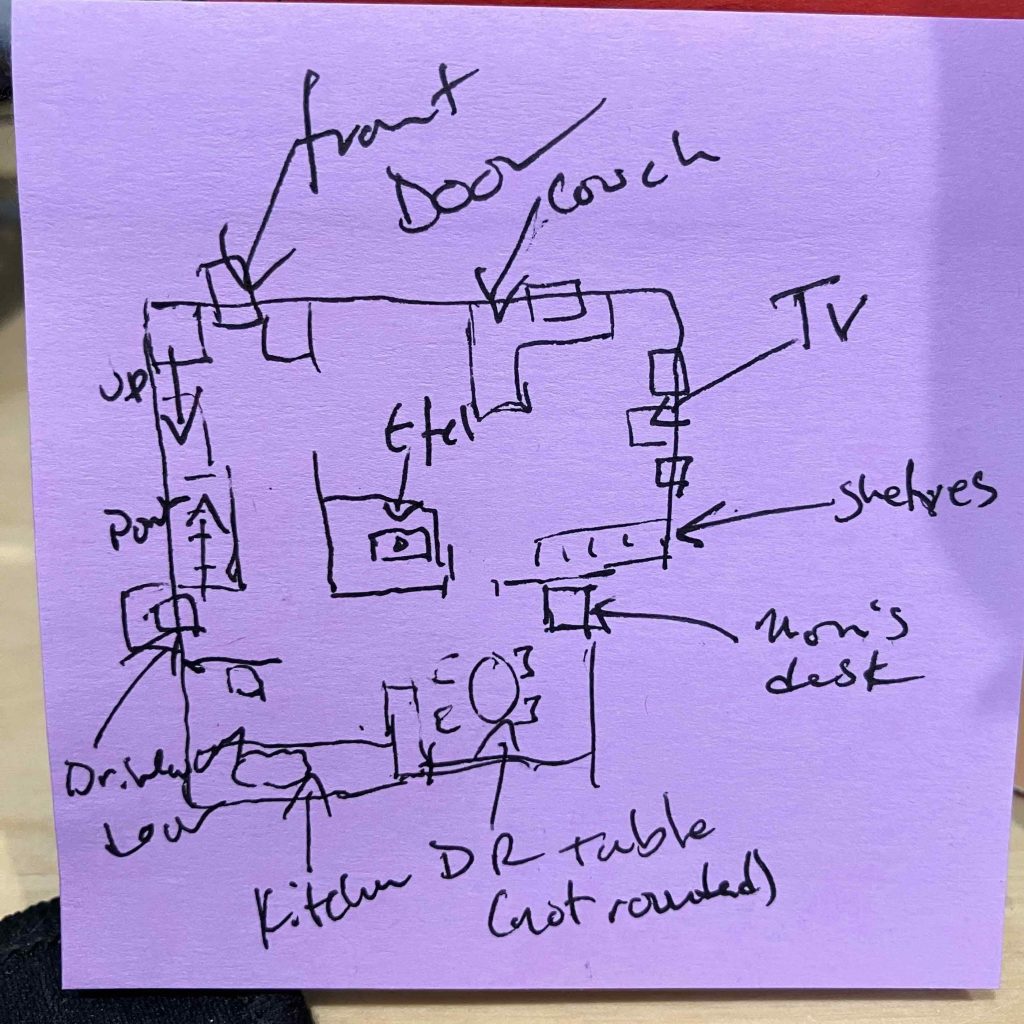
    I have verified the layout of this room with a family member (Image 1), but I cannot confirm the make and model of this television as I was in kindergarten and more interested in the story on the screen than its vehicle. I have looked through several photo albums to see if someone captured its portrait, but it appears that, throughout the years, my family prioritized photographs of people and places rather than things. (I respect the impulse.)

    A purple sticky note with a sketch of the blueprint of a living room.
    Image 1 [Drawing by Kendall Blake]

    This was the early 1980s, so I can only assume that the television was beautiful, had a sturdy knob for changing the channel, and a mysterious set of antennae. That is how I imagine it even if this imagining is an amalgamation of the televisions I saw on my shows, an insistent photocopy of a photocopy.  

    I was a corduroy pants enthusiast, a fan of singing on the swings, and intensely nosy curious about everyone I met. I only had a vague understanding of the world that existed beyond Sullivan Street and did not have a sense of the in between of the various settings of my world. Northern Maine’s potato fields were 600 miles away and also next door to my best friend’s house (600 feet away). 

    Whatever the reason for my missing the in-between, the people who populated these places became my location markers, and I wanted to know everything about them. I needed to make sure they were real.

    Sketch of a route 209 sign made using black colored pencil

    Signage of my youth

    I was a kid with big feelings that came out in big ways: tantrums, declarations of best friendship, declarations of “it’s not fair,” and a belief that my blankie was a little bit real because of how much I loved it. These feelings seemed so outsized that I often felt embarrassed after the wave of emotion had calmed which was, of course, another feeling. Feelings on feelings on feelings. 

    It was hard for me to imagine all of this happening in other people’s minds. It’s probable, too, that I did not know to imagine it.

    What I did know what that there was an intensity within me I wanted to understand, and I became relentless in my quest. It is this pursuit, of course, that set me on the path for a lifetime of TV feelings. 

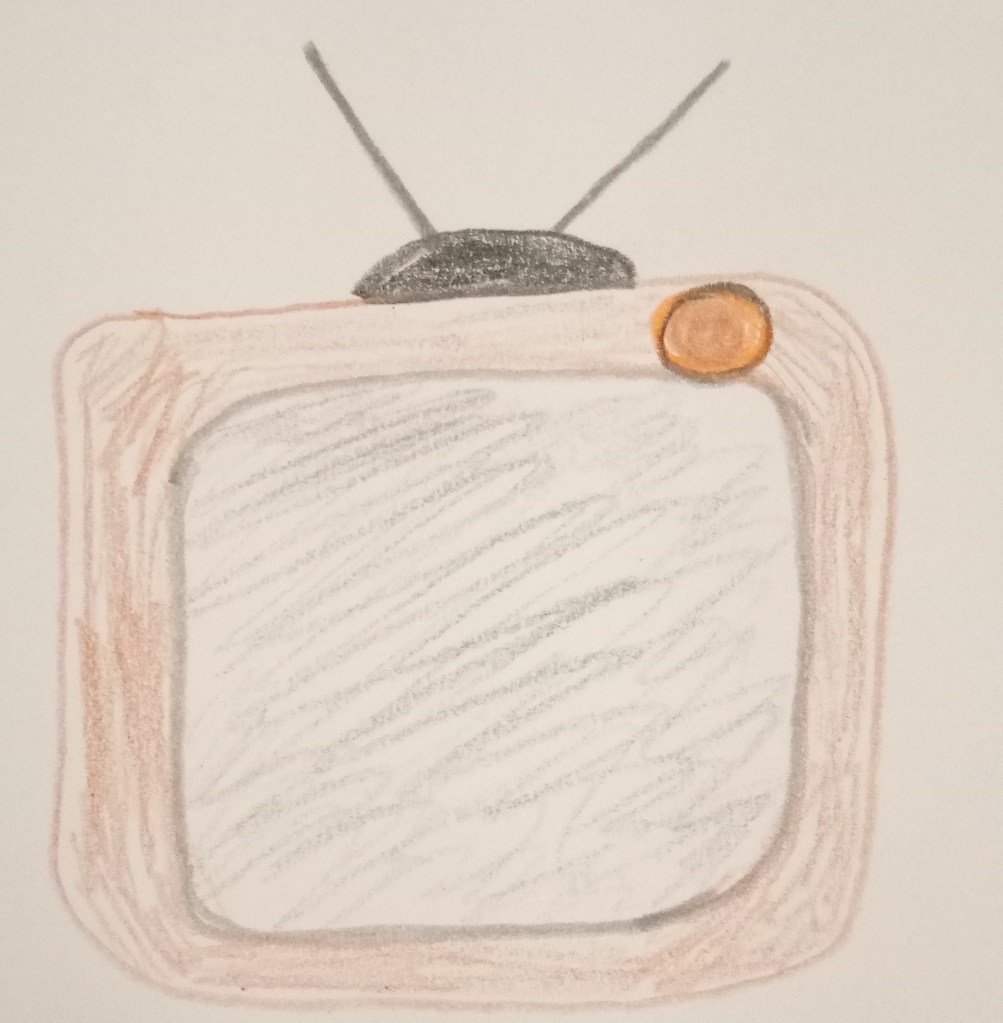
    Sketch of a TV set with classic antennae

    My first TV feeling occurred during an episode of Sesame Street where the A Plot featured Elmo having a sleepover at Maria’s apartment. Maria was one of Sesame Street’s cohort of grownups. She was kind, calm, and incredible at fixing things. Maria was one of The Greats. 

    In the opening scene, Elmo was tucked away in a dresser drawer that doubled as a trundle bed. He explained to the audience that he had awoken early because of an exciting dream but was being good and keeping his voice quiet so as not to wake Maria. This did not last long as Elmo soon succumbed to his instincts and began acting out the whole dream for us, sound effects included. Elmo knew cinema. 

    Maria awoke, deeply confused, and was patient with her guest. (It is likely that this was not a unique occurrence.) She pointed out the clock and how she was due for at least two more hours of sleep. To a grownup, a 5:00 a.m. wakeup versus 7:00 a.m. could be devastating. She tried to explain hours and her schedule and the nature of rest, but this did not resonate with Elmo, who was ready for the day and pancakes. 

    (I knew the feeling.)

    During the pancake cooking segment, Maria told Elmo that there were people who could flip a pancake in the air and it would land batter-side down on the griddle. Elmo egged her on—how could anyone resist! Maria flipped the first pancake like a champ, and perhaps because of this assurance, went in for the second pancake.

    Pancake number two soared high in the air, and, per the rules of situation comedy, adhered itself to the ceiling. Maria looked up (oh, the inevitability of it all) and the pancake loosened itself and fell straight down. Maria’s face was covered with ceiling pancake. 

    Elmo laughed, and Maria pulled the pancake off without a word. She wiped the batter off her face, all the while looking right at the camera with an expression I could not name. 

    Her expression is the crux of my first TV feeling.

    I am sure we can place this moment within the context of psychology. A young child does not recognize an expression and is confused. The child seeks language and calls on her minimal years of experience to find a word that matches.

    But I didn’t have that perspective, nor any perspective, at that age. My life was small and dreamlike. My map of places and feelings was the corner of a notebook page. 

    This isn’t the story of how I found the right word or understanding who I was as a child in the timeline of expected milestones. It’s the story of a feeling, a TV Feeling, and how the child I was grew into the adult I am now because of this influence.

    I am the main character, and the television set is my deuteragonist.

    ***

    Maria did not say how she felt about the ceiling pancake. The rest of the episode moved along in classic fashion: the scenes jumped between more songs and lessons, Maria and Elmo ate their pancakes at breakfast, and the two greeted the morning from the stoop as Elmo informed us of the episode’s sponsors. Then it was done. 

    I thought about the ceiling pancake for weeks. Years, I guess. I was preoccupied with Maria’s expression after she pulled the pancake from her face. I knew that if ceiling pancake landed on my face I would feel embarrassed. My face would scrunch up in that just-about-to-cry-and-I-hate-it way. I would look down, wishing for another feeling.

    Maria didn’t seem embarrassed to me. Or maybe she was and had found a good way to live with embarrassment. Either way, I wanted in: I wanted to know how the experience of ceiling pancake moved around and settled into an emotion in Maria’s mind, an emotion that seemed so different from my own.

    There were so many ways to be and to feel, and I wanted to learn them all.

    My first TV feeling: Seeking.